

Battle of the Centaurs
in bronze
by Michelangelo
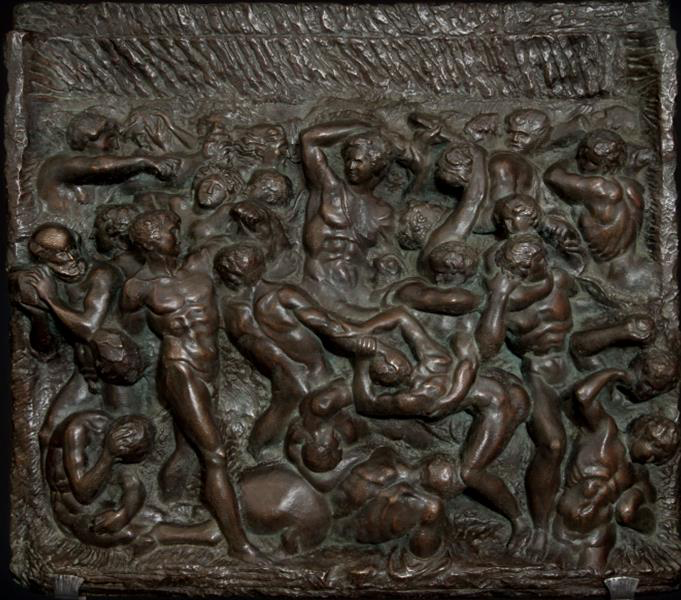
Specifications
Artist: Michelangelo di Lodovico Buonarroti Simoni (Florence 1475-1564 Rome)
Title: “Battaglia Centauri” (circa 1492)
Bronze, Brown patina
Edition Size: Bronze Cast #3/8 of the only authorized posthumous edition of 12 (consisting of #1-#8 and #1-#4 Foundry Proofs) cast from Casa Buonarroti Foundation’s only mold.
Dimensions: H: 31” x W: 35” x D: 4” (Approximate size.)
Signature: Signed in the cast: “MICHAEL.AGELVS.BONAROTVS.FLORENT.FACIEBAT”
Date: Casting Date is 2008
Residence: Crozier Bonded Fine Art Storage Facility
Insured By: Lloyds of London
Current Insured Schedule Value: $5,000,000
PREMR Issued: 317,520
The Battle That Started It All
In 1492, a seventeen-year-old Michelangelo Buonarroti took a block of marble and did something that should have been impossible — he rendered chaos in stone.
Battle of the Centaurs is not merely an early work. It is a declaration. A prodigiously young artist announcing, with hammer and chisel, exactly what he was capable of. The piece depicts the legendary clash between the Lapith tribe and the Centaurs — a mythological eruption of violence that began, as the greatest catastrophes often do, at a wedding, when the centaur guests, drunk and ungovernable, attempted to seize the Lapithian women, bride included. Michelangelo drew from the myth but transcended it entirely. What he rendered in marble was not a story. It was the raw, writhing physicality of struggle itself — bodies locked in combat, muscles straining against marble, chaos made permanent. It remained, by the Master's own account, his most prized work from his early years.
It is the first piece in The Premier Art Collection. And that is not a coincidence.
A Beginning Worth Examining
Premier, like Michelangelo, begins from a position of uncommon promise. And like Battle of the Centaurs, the full significance of this opening statement reveals itself only to those willing to look past the surface.
Some will raise an eyebrow at the choice. Why anchor a premier digital currency— one built on blockchain transparency and cultural mission — with a bronze, posthumous cast? It is a fair question, asked by those who have not yet understood the full arc of this piece's extraordinary history.
Because the story of Battle of the Centaurs does not end at Michelangelo's final chisel strike.
The Medici, the Myth, and the Marble
Michelangelo created the original work for Lorenzo de' Medici — Lorenzo the Magnificent — patriarch of the most powerful cultural dynasty the Renaissance produced. It was the poet and scholar Angelo Poliziano who first suggested the subject: the legendary battle between the Lapiths and the Centaurs. Michelangelo accepted the challenge, then quietly made it his own — setting aside the narrative obligations of myth in favor of something more primal, more urgent, more enduring.
He never finished it.
When Lorenzo died in 1492, Michelangelo set down his chisel and never returned to the work. Whether from grief, displacement, or the particular silence that follows the loss of a great patron, the piece remained — intentionally or not — suspended in a moment of furious, unresolved motion. The original marble has resided at Casa Buonarroti in Florence ever since, a monument to what was, and to what might have been.
The Molds That Saved a Legacy
In the years before the Second World War, with Europe moving inexorably toward catastrophe, the Marinelli Foundry — the Fonderia Artistica Ferdinando Marinelli in Florence — was entrusted with an act of extraordinary cultural foresight. Working directly from the original masterworks of the Italian masters, they created precise plaster molds, taken from the originals themselves, designed to preserve those legacies should the unthinkable occur.
The war came. The originals survived. So did the molds.
In the decades that followed, the Italian Ministry of Culture authorized a maximum of twelve castings from each set of molds — twelve, and no more. It is a number that speaks to the weight of what these castings represent. They are not reproductions. They are not interpretations. They are extensions of the original — new lives for works that were never meant to remain confined to the institutional halls of Italy alone.
One of those twelve authorized castings of Battle of the Centaurs now anchors The Premier Art Collection.
Still at the Frontier
Michelangelo spent his life pushing against the boundaries of what was possible. At seventeen, he rendered the chaos of myth in marble. At eighty-eight, he was still designing the dome of St. Peter's Basilica. He did not recognize limits as permanent conditions — only as the current edge of what had yet to be attempted.
His works remain there still.
Battle of the Centaurs was never finished. Perhaps that was always the point. Some works are not meant to be completed. They are meant to be continued.
The Premier Collection has begun.